For stars less than 8 times the mass of the sun:
* White Dwarf: The core of the star collapses under its own gravity until it becomes incredibly dense. Electrons are packed tightly together, creating a state called "electron degeneracy pressure" which prevents further collapse. White dwarfs are incredibly hot, but they slowly cool over billions of years.
For stars between 8 and 20 times the mass of the sun:
* Neutron Star: The core collapses even further than in a white dwarf, forcing protons and electrons to combine into neutrons. This creates a neutron star, a tiny object with incredibly high density. Neutron stars are only about 20 km across, but they can be several times more massive than the sun.
For stars more than 20 times the mass of the sun:
* Black Hole: The core collapses so intensely that gravity overcomes all forces, creating a black hole. A black hole is a region of spacetime where gravity is so strong that nothing, not even light, can escape.
Other possibilities:
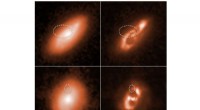
* Supernova: When a star collapses, it can trigger a massive explosion called a supernova. This explosion can be incredibly bright, outshining an entire galaxy for a short period of time.
* Gamma-Ray Burst: Some supernovae produce a powerful burst of gamma rays called a gamma-ray burst. These are the most powerful explosions known in the universe.
It's important to note: The formation of a white dwarf, neutron star, or black hole is a complex process. There are many factors that influence the final outcome, including the star's initial mass, its chemical composition, and its rotation rate.