1. Telescopes:
* Ground-based telescopes: Powerful telescopes on Earth, like the Very Large Telescope in Chile, capture light from celestial objects. Advanced optics and adaptive optics systems help compensate for atmospheric distortion, providing clearer images.
* Space telescopes: Telescopes launched into space, like the Hubble Space Telescope and the James Webb Space Telescope, operate above the Earth's atmosphere, eliminating distortion and enabling observations in various wavelengths of light (visible, infrared, ultraviolet). This allows us to study objects in greater detail and explore the universe in ways not possible from Earth.
2. Spectroscopy:
* Analyzing starlight: By analyzing the light from stars, astronomers can determine their composition, temperature, and speed. This information helps understand the star's evolution and its planetary system.
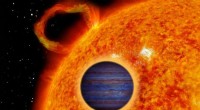
* Exoplanet detection: Spectroscopy can also detect planets orbiting distant stars. When a planet passes in front of its star, it blocks a tiny amount of light, revealing the planet's size and orbital period.
3. Spacecraft missions:
* Orbiting spacecraft: Spacecraft like the Juno mission orbiting Jupiter and the Cassini mission orbiting Saturn provide detailed images and data about planets, their atmospheres, and their moons.
* Landers and rovers: Missions like the Mars rovers Curiosity and Perseverance explore the surface of planets, collecting samples and conducting experiments to understand their geology, climate, and potential for past or present life.
4. Data analysis and processing:
* Supercomputers: Astronomers use powerful supercomputers to process vast amounts of data from telescopes and spacecraft, creating detailed models of planets, stars, and galaxies.
* Machine learning: Artificial intelligence and machine learning algorithms are increasingly being used to analyze data, identify patterns, and make predictions about celestial objects.
5. Other technologies:
* Laser interferometry: Techniques like Very Long Baseline Interferometry (VLBI) combine data from multiple telescopes to achieve extremely high resolution images, enabling us to study details of distant stars and galaxies.
* Gravitational wave detectors: Instruments like LIGO and Virgo detect ripples in spacetime called gravitational waves, offering a new way to study black holes, neutron stars, and other extreme cosmic events.
These technologies work together to provide a comprehensive understanding of the cosmos. By continuously improving and developing new tools, scientists can push the boundaries of our knowledge and answer fundamental questions about our place in the universe.