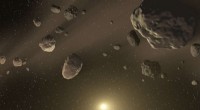
Here's a breakdown of the hypothesis:
* Theia: This hypothetical object is named after the Greek goddess of the moon, who was the mother of Selene (the Moon goddess). It's theorized to have been a large, Mars-sized protoplanet that was orbiting the Sun in the early solar system.
* Collision: Theia and the early Earth collided at a relatively low speed. This impact was not a head-on collision, but more like a glancing blow.
* Formation of the Moon: The impact of Theia sent a massive amount of debris into orbit around the Earth. Over time, this debris coalesced, forming the Moon.
* Evidence: Several pieces of evidence support the binary star hypothesis:
* Lunar composition: The Moon's composition is remarkably similar to Earth's mantle, which suggests that it originated from Earth itself.
* Angular momentum: The Earth-Moon system has a high angular momentum, which is consistent with the impact scenario.
* Tidal forces: The Moon's gravitational pull creates tidal forces on Earth, and these forces are consistent with the Moon having a relatively large mass compared to its size.
Alternative Theories: While the binary star hypothesis is the most widely accepted explanation for the Moon's formation, alternative theories do exist, such as the co-formation theory (the Moon and Earth formed simultaneously from the same accretion disk) and the capture theory (the Moon was captured by Earth's gravity).
Current Research: Scientists continue to study the Moon's composition, structure, and history to further refine their understanding of its formation and to test the validity of the binary star hypothesis. Missions like the Apollo program and recent lunar orbiters have provided valuable data that helps scientists unravel the mysteries surrounding the Moon's origin.