You are likely referring to the discovery of exoplanets using the radial velocity method.
Here's how it works:
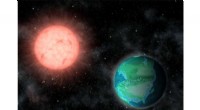
* Stars wobble: A planet orbiting a star exerts a gravitational pull on the star, causing it to wobble slightly.
* Doppler effect: This wobble changes the star's light slightly, either shifting it towards the blue end of the spectrum (blueshift) as the star moves towards us, or towards the red end (redshift) as it moves away.
* Measuring the wobble: Astronomers use sensitive instruments (spectrographs) to measure these minute shifts in the star's light. The size and frequency of the wobble reveal information about the planet's mass and orbital period.
This method is not specifically designed for finding Jupiter-sized planets. It can detect planets of various sizes, depending on the sensitivity of the instrument and the distance between the planet and its star.
However, the radial velocity method was crucial in discovering many large, Jupiter-like exoplanets, including:
* 51 Pegasi b: The first exoplanet discovered around a Sun-like star, in 1995. It is a gas giant slightly larger than Jupiter, orbiting its star very closely.
* HD 209458 b: Another gas giant, slightly larger than Jupiter, known for being a "hot Jupiter" due to its close orbit around its star.
Therefore, while the radial velocity method is not specifically designed for finding Jupiter-sized planets, it has been instrumental in discovering many such planets.