1. Neutron Stars:
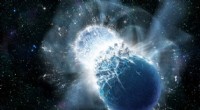
* Formed from stars with initial masses between 8 and 20 solar masses.
* Extremely dense objects where protons and electrons have been crushed together to form neutrons.
* They have a radius of only about 10-20 kilometers, yet their mass is about 1.5 to 3 times that of the Sun.
* They can spin incredibly fast, producing powerful magnetic fields that generate radio waves, making them visible as pulsars.
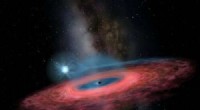
2. Black Holes:
* Formed from stars with initial masses greater than 20 solar masses.
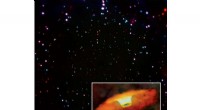
* Objects with such strong gravity that nothing, not even light, can escape their pull.
* They are defined by their event horizon, a point of no return beyond which gravity is too strong.
* We can only observe black holes indirectly, through their effects on surrounding matter.
Note: The exact boundary between neutron star and black hole formation is not precisely defined, and can vary based on different models and observations.
Other possible remnants:
* Supernova Remnants: The expanding clouds of gas and dust left behind by a supernova explosion, the event that marks the death of a high mass star.
* Magnetars: Highly magnetized neutron stars with extremely strong magnetic fields, up to a quadrillion times stronger than Earth's.
The specific remnant a high-mass star leaves behind depends on various factors like the star's initial mass, rotation, and composition.