Low-mass stars (less than 8 solar masses)
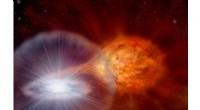
* White dwarf: After exhausting their nuclear fuel, these stars shed their outer layers, leaving behind a dense, hot core called a white dwarf. White dwarfs are primarily composed of carbon and oxygen, and they slowly cool and fade over billions of years.
Intermediate-mass stars (8-25 solar masses)
* Neutron star: These stars undergo a core-collapse supernova, where their core collapses under gravity. The protons and electrons in the core combine to form neutrons, creating a super-dense object called a neutron star. Neutron stars are incredibly small (about 20 km in diameter) but incredibly massive, with a density comparable to that of an atomic nucleus.
High-mass stars (over 25 solar masses)
* Black hole: These stars also undergo a core-collapse supernova, but the core collapses so intensely that it creates a singularity – a point of infinite density and zero volume. This singularity has such strong gravity that not even light can escape, creating a black hole.
Other possibilities:
* Supernova remnant: The explosion of a massive star leaves behind a cloud of expanding gas and dust called a supernova remnant. These remnants can contain heavier elements forged in the star's core and can serve as nurseries for new stars.
* Pulsar: Some neutron stars are highly magnetized and rotate rapidly, emitting beams of radiation from their poles. These objects are called pulsars, and their regular pulses can be detected from Earth.
It's important to remember:
* Stellar remnants are the end products of stellar evolution, and they can take billions of years to form.
* The exact type of stellar remnant that forms depends on the star's mass, composition, and its evolutionary history.
* Our understanding of stellar remnants is still evolving as we continue to study the universe with powerful telescopes.
This is just a brief overview. The topic of stellar remnants is complex and fascinating, and there's much more to learn about these enigmatic objects!