1. The Solar System:
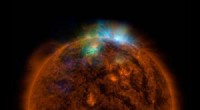
* The Sun: its properties, structure, and activity.
* Planets: their formation, characteristics, atmospheres, and moons.
* Asteroids, comets, and meteoroids.
2. Stars:
* The life cycle of stars: from birth in nebulae to their eventual demise.
* Different types of stars: their size, temperature, and luminosity.
* Stellar clusters and galaxies.
3. Galaxies:
* Types of galaxies: spiral, elliptical, and irregular.
* The Milky Way galaxy: its structure, composition, and position in the Universe.
* Galaxy clusters and superclusters.
4. Cosmology:
* The Big Bang theory and the expansion of the Universe.
* Dark matter and dark energy.
* The evolution of the Universe.
5. Astronomical tools and methods:
* Telescopes: optical, radio, and space telescopes.
* Spectroscopy and photometry.
* Astrometric techniques.
6. Fundamental concepts:
* Celestial coordinates and time.
* Newtonian mechanics and gravity.
* Electromagnetic radiation.
* Basic physics and chemistry relevant to astronomy.
General astronomy is typically the starting point for anyone interested in learning about the universe. It provides the essential knowledge and framework for further specialized studies in astrophysics, planetary science, cosmology, or other related fields.
Here are some key aspects of general astronomy:
* It focuses on the observable universe and phenomena that can be studied with telescopes and other instruments.
* It emphasizes understanding the fundamental laws of physics and chemistry that govern the behavior of celestial objects.
* It bridges various disciplines, including physics, mathematics, chemistry, and even history and philosophy.
* It promotes curiosity and wonder about our place in the universe and the vastness of the cosmos.
General astronomy courses are often offered at introductory levels for students of all backgrounds, providing a fascinating glimpse into the mysteries of the universe.