The Challenges:
* No Atmosphere: Unlike Earth, space has a near-perfect vacuum. Temperature, as we understand it (related to the movement of molecules), doesn't really apply in this context.
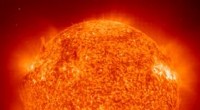
* Radiation: Instead of air molecules, space is filled with radiation, both from the sun and other celestial objects. This radiation carries energy, and that's what instruments actually measure.
* Vastness: Space is incredibly large and temperatures can vary drastically depending on location and proximity to heat sources like stars.
How it's Measured:
Scientists use specialized instruments to measure radiation, which can then be converted into temperature values:
* Infrared Thermometers: These instruments measure the infrared radiation emitted by objects. Since hotter objects emit more infrared radiation, this can be used to determine their temperature.
* Radiometers: These devices measure the total radiation received from a specific region of space. This can be used to determine the overall temperature of that region.
* Spectrometers: These instruments analyze the spectrum of light emitted from objects, allowing scientists to determine their temperature and composition.
Interpreting the Results:
It's important to understand that the temperatures measured in space aren't the same as the "feels like" temperature we experience on Earth. Here's a breakdown:
* Kinetic Temperature: This refers to the average kinetic energy of particles in a substance, which we typically think of as "temperature." It's not directly measured in space.
* Radiation Temperature: This is the temperature that an object would have if it were in thermal equilibrium with the radiation field surrounding it. This is what instruments actually measure.
Example:
The average temperature of the cosmic microwave background radiation is about 2.7 Kelvin (-454.8 degrees Fahrenheit). This means that if you were in space, surrounded by this radiation, you would be absorbing that energy and your body would eventually reach that temperature. But this doesn't mean there's a uniform "air" temperature of -454.8 degrees F throughout the universe.
In conclusion, measuring temperature in space is a complex process that involves understanding the interaction of radiation and matter. It's not just about measuring "air" temperature like we do on Earth, but rather about quantifying the energy carried by radiation.