1. Nova Outburst:
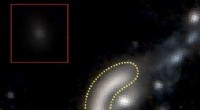
* Mechanism: If the accretion rate is relatively slow, the accreted matter builds up on the surface of the white dwarf, forming a layer of hydrogen. This layer eventually becomes hot and dense enough to ignite nuclear fusion, leading to a sudden and powerful explosion known as a nova.
* Outcome: The nova releases a tremendous amount of energy, brightening the system dramatically for a few weeks or months. The white dwarf is left relatively unchanged, but the companion star may lose a significant amount of mass.
2. Supernova Type Ia:
* Mechanism: If the white dwarf accretes matter at a faster rate, it can eventually reach the Chandrasekhar limit (1.4 solar masses), the maximum mass a white dwarf can sustain. This mass limit triggers runaway nuclear fusion throughout the entire white dwarf, leading to a catastrophic explosion known as a Type Ia supernova.
* Outcome: The explosion is extremely energetic and completely destroys the white dwarf, leaving behind a rapidly expanding cloud of debris. This type of supernova is particularly important for astronomers as it provides a standard candle, a tool for measuring distances in the universe.
3. Formation of an Accretion Disk:
* Mechanism: As the companion star's material spirals toward the white dwarf, it can form a rotating disk of gas around the white dwarf called an accretion disk.
* Outcome: The accretion disk can produce intense X-ray emission as the material falls inward. This emission can be used to study the properties of the white dwarf and the accretion process.
4. Possible Formation of a Neutron Star or Black Hole:
* Mechanism: In rare cases, if the white dwarf is already massive and accretes a significant amount of matter from its companion, it might collapse directly into a neutron star or even a black hole.
* Outcome: This scenario is less common but would result in a much more powerful explosion than a nova or a Type Ia supernova.
In summary:
The accretion of matter from a companion star onto a white dwarf can have profound consequences, leading to nova explosions, Type Ia supernovae, the formation of accretion disks, and even the potential creation of neutron stars or black holes. These events are crucial to understanding the evolution of stars and galaxies.