* Density is mass divided by volume.
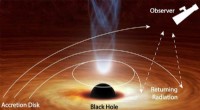
* Black holes have a singularity at their center, a point of infinite density. This means an infinite amount of mass is compressed into a point with zero volume.
While the idea of infinite density is hard to grasp, it's important to remember:
* We can't directly observe the singularity. Our understanding of physics breaks down at such extreme conditions.
* The density of the event horizon is still incredibly high. The event horizon is the point of no return around a black hole. The density at the event horizon is much higher than any other known object in the universe.
Comparison to other celestial objects:
* Neutron stars: These are the densest known objects besides black holes. They have about 1.5 times the mass of our Sun compressed into a sphere only about 20 kilometers wide.
* White dwarfs: These are denser than normal stars, but much less dense than neutron stars.
* Normal stars: These have a much lower density than white dwarfs or neutron stars.
* Planets: Even less dense than stars, planets are mostly made of gas and rock.
In short, black holes are incredibly dense, and their singularity is considered infinitely dense. However, understanding this concept requires acknowledging the limitations of our current understanding of physics.