Here's how it works:
1. Formation of the Solar Nebula: The solar system began as a giant cloud of gas and dust called a nebula. This nebula had some initial rotation, even if it was very slow.
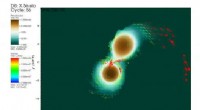
2. Gravitational Collapse: Gravity caused the nebula to collapse inward. As it collapsed, the material got closer to the center and had to spin faster to conserve angular momentum. This is like an ice skater spinning faster when they pull their arms in.
3. Formation of a Disk: The rapid rotation flattened the collapsing nebula into a disk. All the material in the disk was moving in the same direction and roughly on the same plane.
4. Planet Formation: Within this disk, dust and gas particles began to clump together under gravity, eventually forming the planets. Since they formed from material already moving in the same direction and plane, the planets inherited that motion, resulting in the observed pattern of nearly circular orbits in the same plane and direction.
Therefore, the conservation of angular momentum during the formation of the solar system is the key factor that explains why the planets all orbit in the same direction and plane.