Instead, scientists measure the mass of planets. Mass is a fundamental property of matter and doesn't change depending on location. Here's how they do it:
1. Kepler's Laws:
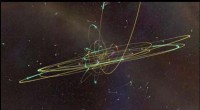
* Kepler's Third Law states that the square of a planet's orbital period (the time it takes to orbit the sun) is proportional to the cube of its average distance from the sun.
* By observing a planet's orbital period and distance from the sun, scientists can calculate its mass.
2. Gravitational Interactions:
* Planets exert gravitational pull on each other.
* Scientists can measure the tiny wobbles in a star's motion caused by the gravitational pull of its planets.
* The strength of these wobbles allows them to calculate the masses of the planets.
3. Spacecraft Flybys and Orbits:
* When a spacecraft flies by or orbits a planet, its trajectory is affected by the planet's gravity.
* By carefully tracking the spacecraft's motion, scientists can determine the planet's gravitational field and subsequently its mass.
4. Studying Moons:
* The orbits of moons around planets are also affected by the planet's gravity.
* By studying the moon's orbital period and distance from the planet, scientists can calculate the planet's mass.
In summary: While we can't directly measure the "weight" of planets, scientists use various methods to accurately determine their mass. This mass is a fundamental property and allows us to understand the planet's gravitational influence and its place in the solar system.