Rotation:
* Definition: The spinning of a planet on its axis.
* Axis: An imaginary line passing through the planet's center, connecting the North and South poles.
* Result: Day and night cycles. The side facing the Sun experiences daytime, while the opposite side experiences nighttime.
Revolution:
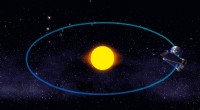
* Definition: The movement of a planet around a star (e.g., Earth around the Sun).
* Axis: The planet's orbit, which is an elliptical path around the star.
* Result: Seasons and the year. The Earth's tilted axis and revolution around the Sun cause different hemispheres to receive varying amounts of sunlight throughout the year, resulting in seasons.
Key Differences:
* Axis: Rotation occurs around an internal axis, while revolution occurs around an external point (the star).
* Duration: Rotation is much faster than revolution. Earth completes one rotation in approximately 24 hours, but one revolution takes 365 days.
* Consequences: Rotation creates day and night, while revolution causes seasons and the year.
Think of it this way:
* Rotation: Imagine spinning a top. The top spins on its own axis.
* Revolution: Imagine a child spinning around a maypole. The child is moving around a central point.
In conclusion, rotation and revolution are separate and distinct movements of a planet, each with different axes, durations, and consequences.