1. Observing the effects of their immense gravity:
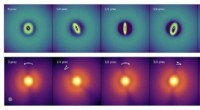
* Accretion Disk: Black holes pull in matter from surrounding space, forming a swirling disk of gas and dust called an accretion disk. This disk heats up due to friction, emitting radiation across the electromagnetic spectrum, including visible light, X-rays, and radio waves. This radiation can be observed by telescopes, revealing the presence of the black hole.
* Gravitational Lensing: The extreme gravity of a black hole can bend the path of light from distant objects behind it, acting like a giant magnifying glass. This bending of light, known as gravitational lensing, can be observed as distortions or multiple images of the background object.
* Orbital Motion of Stars and Gas: By observing the movement of stars and gas clouds around an unseen object, astronomers can infer its mass. If the mass is incredibly high, concentrated in a small space, it strongly suggests the presence of a black hole.
2. Detecting gravitational waves:
* Gravitational Wave Observatories: When two black holes collide, they emit powerful gravitational waves that ripple through space-time. These waves can be detected by specialized instruments like LIGO and Virgo. The unique pattern of these waves confirms the presence of black holes and provides information about their masses and spins.
3. Observing the emission of jets:
* Jets of Particles: Some black holes, especially those in the centers of galaxies, launch powerful jets of particles that travel at near-light speed. These jets can be detected in radio waves and X-rays, indicating the presence of a black hole.
4. Studying the properties of the surrounding environment:
* Gas and Dust Distribution: The presence of a black hole can influence the distribution of gas and dust in its vicinity, creating distinctive patterns that can be observed with telescopes.
* Star Formation: Black holes can inhibit star formation in their surroundings, creating a void in the distribution of stars.
By combining these various observational techniques, astronomers can confidently detect the presence of black holes, even though they are invisible to optical telescopes.