Celestial objects are categorized as luminous or non-luminous based on whether they emit their own light or reflect the light from another source.
Luminous Objects:
* Stars: The vast majority of luminous objects are stars. They generate their own light through nuclear fusion, a process where lighter elements are converted into heavier ones, releasing tremendous amounts of energy. This energy manifests as light and heat.
* Supernovae: These powerful explosions mark the death of massive stars, releasing an immense burst of light that often outshines entire galaxies for a brief period.
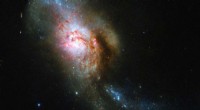
* Nebulae: These clouds of gas and dust can be luminous due to the presence of hot, young stars within them that illuminate the surrounding gas.
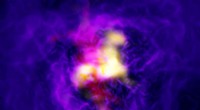
* Active Galactic Nuclei (AGN): Found at the centers of some galaxies, AGN are powered by supermassive black holes accreting matter, releasing immense energy in the form of radiation.
Non-Luminous Objects:
* Planets: Planets like Earth, Mars, or Jupiter do not produce their own light. Instead, they reflect the light from their star.
* Moons: Similar to planets, moons reflect light from their parent star.
* Asteroids: These rocky bodies are too small to emit their own light and primarily reflect sunlight.
* Comets: Although comets can appear bright due to the reflection of sunlight and the release of gas and dust, they do not generate their own light.
* Dark Matter: This mysterious substance, while thought to make up a significant portion of the universe, does not interact with light and remains invisible.
Understanding the Difference:
The key difference between luminous and non-luminous objects lies in their energy source. Luminous objects generate their own light through internal processes like nuclear fusion or accretion, while non-luminous objects simply reflect the light from another source.
Beyond the Binary:
It's important to note that the line between luminous and non-luminous objects is not always clear-cut. Some objects might exhibit both properties:
* Brown dwarfs: These "failed stars" lack the mass to sustain nuclear fusion but can emit weak light due to the heat generated by their gravitational collapse.
* Neutron stars: The incredibly dense remnants of supernovae, these stars emit radio waves, X-rays, and gamma rays. While not visible light, these emissions are still considered "light" in a broader sense.
Ultimately, the distinction between luminous and non-luminous celestial objects is a matter of how we define "light" and how we detect it. Our understanding of the cosmos is constantly evolving, and as we develop new technologies, our perception of these distinctions may change as well.