Redshift:
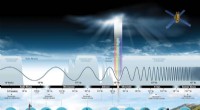
* When light from distant galaxies is observed, its wavelengths are shifted towards the red end of the spectrum. This is known as redshift.
* The further away a galaxy is, the greater its redshift. This means the light is stretched further and further into the red part of the spectrum.
* This redshift is interpreted as a Doppler shift, similar to the way the sound of a siren changes pitch as it moves towards or away from you.
Big Bang Connection:
* The Big Bang theory states that the universe began in a hot, dense state and has been expanding ever since.
* As the universe expands, galaxies move further apart from each other.
* This movement causes the light from distant galaxies to be stretched, resulting in the observed redshift.
Further Evidence:
* Hubble's Law: This law, discovered by Edwin Hubble, states that the redshift of galaxies is proportional to their distance from us. This observation directly supports the idea of an expanding universe.
* Cosmic Microwave Background Radiation (CMB): This faint radiation is believed to be the afterglow of the Big Bang. Its uniform temperature across the universe is also consistent with an expanding universe.
Summary:
The redshift of galaxies, particularly its relationship to distance (Hubble's Law), strongly supports the Big Bang theory. It provides evidence for the expansion of the universe and the idea that everything we see was once concentrated in a single point.
Important Note: There are other explanations for redshift, like the tired light hypothesis, but these have been ruled out by various observations and are not widely accepted by the scientific community.