1. Reflected Sunlight:
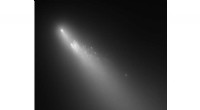
- The most prominent radiation from a comet is reflected sunlight. This includes visible light, infrared radiation, and ultraviolet radiation.
- The dust and ice particles in a comet's coma and tail scatter and reflect sunlight, making them visible to us.
2. Emission due to Solar Radiation:
- When a comet gets close to the Sun, its ice and dust are heated and vaporized.
- This process releases:
- Thermal infrared radiation: As the comet warms up, it emits infrared radiation.
- Ultraviolet radiation: Some of the gases released from the comet absorb and then re-emit UV radiation.
- Radio waves: The interaction of solar radiation with the comet's coma can generate radio waves.
- This emission is usually much weaker than the reflected sunlight.
3. No Radioactive Emission:
- Comets are not radioactive and do not emit radiation like gamma rays or X-rays.
In summary:
Comets primarily reflect sunlight and emit some radiation due to their interaction with the Sun. They do not emit radiation in the same way as stars or radioactive sources.