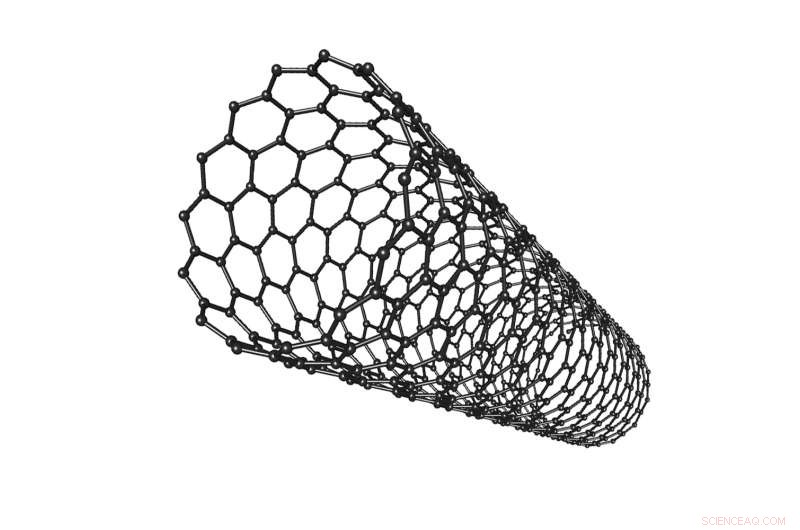
Carbon nanotube. Credit: AJC/flickr/CC BY-SA 2.0
(Phys.org)—A team of researchers with PSL Research University in France and Brown University in the U.S. has found a way to accurately measure the permeability of carbon nanotubes. They have published an outline of their technique in the journal Nature. Angelos Michaelides with University College London offers a News & Views paper outlining the work done by the team in the same journal issue.
Scientists working in various fields have been hard at work studying carbon nanotubes for several years now because of the material's unique and useful properties, one of which is low friction. This particular attribute has come to the attention of engineers and other researchers working on improving desalination devices—less friction in such a device would make it more efficient. But because nanotubes are so small it has been difficult to measure how quickly water is able to move through them—thus far, test results have varied so widely that none can be taken as accurate. In this new effort, the researchers have come up with a technique that is accurate and reliable, suggesting the problem has finally been solved.
Realizing that measuring a liquid moving through a nanotube was not really feasible, at least for now, the researchers instead developed a device that measured the displacement of polystyrene nanoparticles that were large enough to be seen. The device consisted of two small wells containing water that were connected by a single nanotube. The nanoparticles were suspended in the well into which the water would flow as it was ejected by the nanotube. To make the device work, the researchers increased the pressure of the water on the feed side, forcing an extremely tiny stream to be pushed through the nanotube and into the other well. By measuring the displacement of the particles in the output well as the water rushed out, the researchers were able to very accurately measure the rate at which the water moved through the nanotube, and thus the degree of friction involved.
As part of their experiments, the researches tried using nanotubes with different sized radii and discovered that the thinnest nanotubes demonstrated nearly zero friction. In sharp contrast, they found that nanotubes made of boron nitride (which some have suggested might be just as good as carbon nanotubes) were not nearly as slippery.
© 2016 Phys.org