Here's why:
* Transit observations only give information about the size and orbital period. When a planet transits a star, it blocks out a tiny portion of the star's light. The amount of light blocked tells us about the planet's size relative to the star. The time it takes for the planet to complete a transit tells us its orbital period.
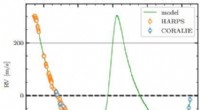
* To determine mass, you need additional information. We can estimate a planet's mass using the gravitational effect it has on the star. This is done through a technique called the radial velocity method. This method detects the "wobble" in the star's motion caused by the planet's gravitational pull.
* Combining transit and radial velocity data gives the best mass estimate. When both transit and radial velocity data are available, astronomers can calculate a planet's mass with much greater accuracy.
So, while transits are incredibly valuable for detecting exoplanets and determining their size and orbital period, they don't directly tell us the planet's mass. You need additional information, like the star's wobble, to make that determination.