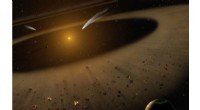
1. Approaching the Sun: As a comet approaches the sun, the solar radiation and solar wind increase in intensity.
2. Heating and Sublimation: This energy causes the ice in the comet's nucleus to heat up and undergo sublimation. Sublimation is the process where a solid directly transforms into a gas, skipping the liquid phase.
3. Gas and Dust Release: The sublimated gas expands and carries dust particles away from the nucleus, forming the comet's coma (the fuzzy atmosphere surrounding the nucleus).
4. Solar Wind Interaction: The solar wind, a stream of charged particles from the sun, interacts with the coma, pushing the gas and dust particles away from the sun, creating the comet's tail.
5. Tail Formation: The dust tail, composed of larger particles, tends to be curved due to the comet's orbital motion. The gas tail, composed of ionized gases, is pushed directly away from the sun by the solar wind, creating a straight, bluish tail.
Factors Affecting Vaporization:
* Distance from the Sun: The closer the comet gets to the sun, the more intense the solar radiation and the faster the vaporization.
* Composition: The type of ice and the amount of volatile materials (like carbon dioxide and methane) in the comet can influence the vaporization rate.
* Size and Shape: A larger nucleus has more surface area for vaporization, while a more irregular shape can expose more ice to the sun.
Overall, the vaporization process is a continuous cycle driven by the sun's energy, transforming the comet's frozen material into a spectacular display of gas and dust.