1. Supermassive Black Hole:
* The most likely candidate is a supermassive black hole (SMBH). These behemoths reside at the heart of most galaxies, including our own Milky Way. They are incredibly dense, with gravity so strong that not even light can escape. While black holes themselves are invisible, the intense gravitational pull of a SMBH attracts surrounding gas and dust, forming a bright accretion disk that emits radiation across the electromagnetic spectrum. This radiation can be incredibly powerful, making the SMBH appear as a bright, star-like object in the galaxy's core.
2. Active Galactic Nuclei (AGN):
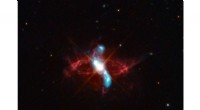
* When a SMBH is actively feeding, it can create an Active Galactic Nucleus (AGN). This is a highly energetic region around the black hole, characterized by powerful jets of material ejected at near-light speed, intense radiation, and emission lines from various elements. AGNs can be incredibly bright, even outshining the rest of the galaxy combined.
3. Supernova Remnants:
* While less common, a supernova remnant could also appear as a bright object in the galaxy core. This is the expanding cloud of gas and dust left behind after a massive star explodes at the end of its life. Supernova remnants can be incredibly bright and luminous, lasting for thousands of years.
4. Star Clusters:
* Finally, dense star clusters located near the galaxy's core can also appear as a bright, star-like object. These clusters contain thousands or millions of stars packed closely together, creating a concentrated source of light.
To determine the exact nature of the mysterious object, astronomers need more information:
* Spectral Analysis: Studying the object's spectrum can reveal its chemical composition, temperature, and velocity. These clues can help distinguish between a black hole, a supernova remnant, or a star cluster.
* Brightness and Variability: The object's brightness and whether it varies over time can also provide valuable insights. Black holes and AGNs often exhibit significant variability, while supernova remnants typically fade over time.
* Location within the Galaxy: The object's position relative to the galactic center can also offer clues. Supermassive black holes are always located at the very center of the galaxy, while supernova remnants and star clusters can occur in other regions.
Ultimately, a combination of observations and analysis is needed to uncover the true identity of a mysterious bright object in a galaxy's core. Each discovery can contribute to our understanding of the complex and fascinating processes occurring at the heart of these celestial systems.