* The Big Bang: This theory describes the universe starting from an incredibly hot and dense state about 13.8 billion years ago. This state expanded rapidly, cooling and evolving into the universe we see today.
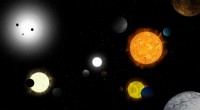
* Planets: Planets formed much later within the universe, long after the Big Bang. They formed from the dust and gas left over from the early universe.
Think of it this way: Imagine a balloon being inflated. The air inside the balloon represents the universe, and the balloon itself represents the expanding space. The Big Bang is like the moment the balloon is blown up – the universe starts expanding from a tiny point. Planets are like small stickers placed on the balloon after it's been inflated. They weren't there at the beginning.
The Big Bang theory is supported by a vast amount of scientific evidence, including:
* Cosmic Microwave Background Radiation: This faint afterglow of the Big Bang can be detected throughout the universe.
* Redshift of Distant Galaxies: Galaxies further away from us are moving away faster, supporting the idea of an expanding universe.
* Abundance of Light Elements: The Big Bang theory predicts the abundance of light elements like hydrogen and helium, which is consistent with observations.
So, the Big Bang is a much grander event than planets crashing into each other. It's the origin of everything in the universe, including the planets themselves.