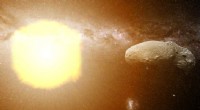
* Orbital Velocity: Asteroids in the belt are constantly moving, orbiting the Sun at high speeds. This orbital velocity creates a centrifugal force that counteracts the Sun's gravitational pull, preventing them from falling inward.
* Gravitational Balance: The asteroid belt's location between Mars and Jupiter is a region of relative gravitational stability. The combined gravitational influence of Jupiter and the Sun keeps the asteroids in their orbits, preventing them from spiraling inwards.
* Collisions: While not a prevention mechanism, collisions within the belt can actually increase the chances of an asteroid being ejected into an orbit that brings it closer to the inner planets. These collisions can alter an asteroid's velocity and trajectory, potentially leading to a path that intersects with Earth's orbit.
Here's a simplified analogy: Imagine an object spinning on a string. The object's outward motion (centrifugal force) counteracts the string's inward pull (centripetal force). This is similar to how asteroids in the belt stay in their orbits.
It's important to remember that while the asteroid belt is a relatively stable region, occasional collisions or other gravitational perturbations can still send asteroids on new trajectories, potentially threatening the inner planets. This is why we continue to monitor near-Earth objects (NEOs) and develop strategies for planetary defense.