Here's a breakdown:
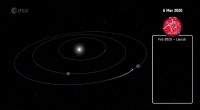
* Elliptical Orbit: Mercury's path around the Sun is not a perfect circle but rather an oval shape.
* Eccentricity: This oval shape is significantly elongated, meaning the difference between Mercury's closest and farthest points from the Sun is large.
* Speed: Mercury travels faster when it's closer to the Sun (at perihelion) and slower when it's farther away (at aphelion). This is due to Kepler's Laws of Planetary Motion, which state that a planet sweeps out equal areas in equal times.
Here are some key points to remember:
* Orbital Period: Mercury takes about 88 Earth days to complete one orbit around the Sun.
* Orbital Velocity: Mercury's average orbital speed is about 47 kilometers per second (29 miles per second).
* Rotation: Mercury rotates on its axis once every 59 Earth days, which is slower than its orbital period.
* Tidal Locking: Mercury is not tidally locked to the Sun, meaning it doesn't always show the same face to the Sun.
This unique combination of orbital characteristics makes Mercury's journey around the Sun a fascinating example of celestial mechanics in action.