Are there other forms of life in the universe? The scientific search for extraterrestrial life forms has been bolstered by two recent discoveries. First, the discovery of life forms in exotic environments on Earth indicates that life is very hearty and can adapt to the strangest and most hostile environments. Second, astronomers found planets orbiting stars besides our sun -- over 50 extrasolar planets have been discovered as of 2001. Are there alien life forms on any of these planets?
If alien life does exist, what might it be like? Would it be simple forms of life such as bacteria, viruses or algae, or more advanced, multi-cellular creatures, perhaps even intelligent beings? Would aliens be animals, plants or have characteristics of both? Would they have arms and legs and walk upright as we do? Would they depend upon vision as their primary sense or use another way to gather information about their surroundings? Would they "breathe" oxygen or some other gas?
Speculation about aliens has typically been left to science-fiction authors, science-fiction readers and Hollywood writers and directors. In this article, we will examine astrobiology, the scientific search for extraterrestrial life. We'll apply what we have learned about life on Earth to speculate about what alien life forms might be like.
ContentsMost of us picture alien life the way it's portrayed in movies, where aliens are commonly depicted as human-like forms because they use actors either to play the roles directly in make-up or to be models for computer-generated animation. Also, audiences relate to human-like aliens better than to more exotic, monster-like creatures. However, the human body plan -- bilateral symmetry with one head, two legs and two arms -- stems from when early amphibians and reptiles colonized the Earth's land masses, and it seems unlikely that such a shape would evolve on an alien world. So, let's forget Hollywood for the moment and look closely at the real science of astrobiology.
Astrobiology is the scientific study of life in the universe. Astrobiologists seek to understand (among other things) how life arose and evolved on Earth, what governs the way life is organized and what makes a planet habitable.
Astrobiology combines the disciplines of biology, chemistry, physics, geology and astronomy. Often, astrobiologists must use the information learned about life on Earth as a guide for studying life elsewhere. Let's examine some of the things that we have learned from life on Earth.
 Club-shaped structures of underwater microbes called stromatolites
Photo courtesy NOAA/U.S. Dept. of Commerce
Club-shaped structures of underwater microbes called stromatolites
Photo courtesy NOAA/U.S. Dept. of Commerce
While it is hard to pen a clear definition of "life," most biologists agree that there are many characteristics in common among living things. If an object meets these characteristics, it is considered alive:
Now that we've got a definition of what life is, we need to look at how it changes over vast expanses of time. The basic rules governing whether species arise, live, remain unchanged or become extinct are those of evolution by natural selection as proposed by Charles Darwin. Darwin's theory of evolution has the following points to it:
Although Darwin's theory of evolution was proposed to explain changes in Earth-based species, its principles are general enough that it could be applied elsewhere in the universe as well.
Rare Earth HypothesisThe Drake equation, developed by astronomer Frank Drake and promoted by Carl Sagan, is used to estimate the number of intelligent civilizations in the universe. In contrast, geologist Peter Ward and astronomer Donald Brownlee from the University of Washington have proposed a hypothesis -- the Rare Earth Hypothesis -- that life on Earth is unique. Their hypothesis states that a series of chance events or situations, such as living in the habitable zone of the sun, having a Jupiter-type planet to clear away comet and asteroid debris and having few mass extinctions, has allowed life to develop on Earth and would be unlikely to happen elsewhere. See "Rare Earth: Why Complex Life is Uncommon in the Universe" for details.
 Hydrothermal vent in the ocean floor
Photo courtesy NOAA/U.S. Dept. of Commerce
Hydrothermal vent in the ocean floor
Photo courtesy NOAA/U.S. Dept. of Commerce
Up until about 30 years ago, it was believed that all life on Earth was dependent upon energy from the sun. Furthermore, it was thought that you would probably not find life where temperatures were extremely hot, like in geysers or hot springs, or extremely cold, like in the Antarctic desert.
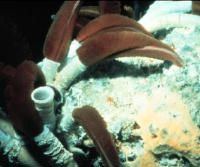
These ideas changed when oceanographers explored hydrothermal vents, openings in the ocean floor where extremely hot, mineral-rich water erupts from the crust. Hydrothermal vents are located several miles below the surface, on the ocean floor, where the surrounding water is at or near freezing, it is absolutely dark and the pressure is high. In organized communities around the bases of these vents, called black smokers, scientists found clams, crabs and exotic, giant tubeworms measuring 6 feet (2 meters) long. The water coming out of these vents is 230 to 662 degrees Fahrenheit (110 to 350 degrees Celsius).
How can these animals survive so far from the sunlight, under these extreme conditions? In the water, scientists found species of bacteria that split hydrogen sulfide from the water to get energy to make organic compounds (chemosynthesis). The tubeworms have bacteria in their tissues that help them derive energy from the water. The clams feed on the bacteria, and the crabs feed on the tubeworms.
The discovery of hydrothermal-vent communities showed that it is possible for life to evolve in places without light from the sun, and in other worlds without sufficient light from the parent star. In view of the discovery of hydrothermal vents, it may be possible that life exists on Europa, an icy moon of Jupiter, which scientists believe has a water ocean beneath its icy crust.
 Tubeworms around a hydrothermal vent
Photo courtesy NOAA/U.S. Dept. of Commerce
Tubeworms around a hydrothermal vent
Photo courtesy NOAA/U.S. Dept. of Commerce
Life has been found in other extreme environments as well. Scientists discovered microcolonies of lichens called cryptoendoliths in rock samples of the Antarctic desert, where temperatures often drop to 100 degrees below zero and there is little or no liquid water. In contrast, thermophilic (heat-loving) bacteria have been found in hot springs where temperatures exceed the boiling point of water.
 Living cryptoendoliths (green, black, green-blue lines) in a rock sample from Antarctica (left) and a thermophilic, rod-shaped bacteria (about 1 micron long) from a hot spring in Yellowstone National Park (right)
Photos courtesy NASA
Living cryptoendoliths (green, black, green-blue lines) in a rock sample from Antarctica (left) and a thermophilic, rod-shaped bacteria (about 1 micron long) from a hot spring in Yellowstone National Park (right)
Photos courtesy NASA
 Living cryptoendoliths (green, black, green-blue lines) in a rock sample from Antarctica (left) and a thermophilic, rod-shaped bacteria (about 1 micron long) from a hot spring in Yellowstone National Park (right)
Photos courtesy NASA
Living cryptoendoliths (green, black, green-blue lines) in a rock sample from Antarctica (left) and a thermophilic, rod-shaped bacteria (about 1 micron long) from a hot spring in Yellowstone National Park (right)
Photos courtesy NASA
If life can evolve in extreme environments on Earth, it seems possible that life may exist in the extreme environments of other worlds such as Mars.
 Batfish
Photo courtesy NOAA/U.S. Dept. of Commerce
Batfish
Photo courtesy NOAA/U.S. Dept. of Commerce
Using what we have learned from life on Earth, what can we say about alien life? While it would probably be vastly different from life on Earth, alien life would probably adhere to certain universal guidelines, as the widely varying life on Earth does. These guidelines or ground rules include the following:
Alien life would be governed by laws of physics and chemistry.
Alien life would be based on some type of chemistry (eliminating the sci-fi concept of pure-energy beings).
Alien beings that are larger than microbes would have some equivalent of cells. As an organism gets larger, its internal volume (cubic function) grows faster than its surface area (square function). This places a limit on the organism's size, because substances from the outside of the organism must pass into and throughout the organism by diffusion, which depends upon large surface areas, short distances and differences in concentrations. As an organism grows larger, the distance to its center increases and diffusion gets slower. To maintain workable diffusion distances, an organism must have many small cells instead of one large cell. So, an alien would be multi-celled if it is larger than a microbe. (We would not expect to find a light-years wide, single-celled organism like that portrayed in the original Star Trek episode "The Immunity Syndrome.")
Alien life would evolve and adapt to its surroundings by the theory of evolution as previously explained.
The physiological make-up of a multi-celled alien would be most suited to its environment. Organ systems would be adapted to environmental conditions such as temperature, moisture and gravity.
Alien organisms would probably have similar ecological structures to life on Earth.
As you can see, life of any kind is intimately tied to its environment, so the characteristics of the planet would be extremely important in determining the characteristics of the life form.
With these ground rules in mind, and since no extraterrestrial life forms have been conclusively discovered, alien physiology lies in the realm of our imagination. Science-fiction authors, especially the 'hard" ones who try to adhere strictly to real science, have been doing this for years. They first design or build a world, carefully working out its physical, astronomical and ecological characteristics. Next, they work out what type of aliens could exist in that world. An example of one such world-building exercise can be found at the Epona Project, where several science-fiction writers came together to create a world called Epona, complete with planetary, geological and ecological data. One artist, Steven Hanly, created Epona creatures.
For his novel "Mission of Gravity," Hal Clement created a world called Mesklin that circles a double star. Mesklin rotates once every eighteen minutes and has a flattened shape caused by its rotation. The gravity of Mesklin ranges from three times Earth's gravity, at the equator, to seven hundred times at the poles. Mesklin has a hydrogen atmosphere and methane oceans. Mesklinites, one of the planet's life forms, are small, centipede-like creatures made of an insect skeletal protein called chitin. They have 18 pairs of legs that end in sucker-like feet, forward pinchers for grasping, a strong circulatory system and absorb hydrogen right through their shells. They are immensely strong -- a result of living on a high-gravity world, yet they have a fear of being picked up because a fall from a small height could be fatal on such high gravity. (See "Barlowe's Guide to Extraterrestrials" and "The Science of Aliens" for descriptions of Mesklinites and other alien life.)
At HowStuffWorks, we've envisioned an alien world and alien life forms. In our world, the planet orbits a bright star. Only 10 percent of the world is covered with surface water, but throughout the land mass there are pockets of water that collect under the sands from the sparse rainfall. The environment is hot and arid and the sunshine is bright. The planet is massive and has gravity that is one-hundred times stronger than that of Earth. The atmosphere is an Earth-like air mixture of helium, oxygen and carbon dioxide.
The two alien life forms that we envision for this world are animals -- mobile predators that live around the planet's few small bodies of surface water. Both aliens are short, about 1 foot (30 centimeters) tall, with thick limbs to support their weight against the immense gravity. Both have thick coverings or skins to minimize evaporation and conserve water. To gather information, one relies primarily on vision, while the other uses chemical senses (taste and smell).
The Lashlarm is our first alien predator. It looks like a walking toilet bowl. The mouth portion is supported by three stalky legs connected to a flat pedestal. Underneath the pedestal are many scales, so the pedestal glides across the surface of the sand much like a snake moves along the ground. It has several sensory appendages that allow it to locate prey by chemical means. It hunts near the small bodies of surface water, feeling along the water's edge and tasting the sand and water for other animals. Upon locating prey, the Lashlarm crouches down and glides up to it. The Lashlarm then opens its large mouth and springs down upon the prey, swallowing it whole.
The Nirba is is slightly larger than the Lashlarm. It lives in the water, near the edge, much like a crocodile or alligator but is not fully aquatic. The Nirba comes out to prey on other animals that come down to the water, particularly the Lashlarm. It has a large head with nostrils located on top of its nose so it can breathe while mostly submerged. The Nirba has thick skin, to prevent dehydration while out of the water in the hot sun, and big, muscular front legs with large claws for killing its prey. A long tail helps it swim in the water, and the "arrowhead" end assists in hunting and territorial defense.
For more information on alien life and related topics, check out the links on the following page.
Alien Speculation References