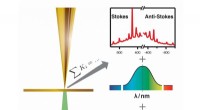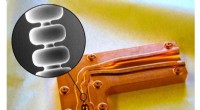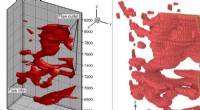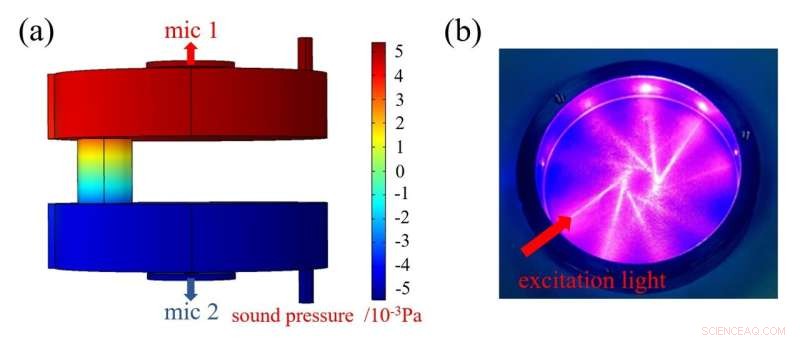
(a). Sound pressure simulation result and (b). Schematic diagram of the light multiple reflection in the novel differential Helmholtz photoacoustic cell. Credit: Li Zhengang
A team from the Hefei Institutes of Physical Science of the Chinese Academy of Sciences has developed a high-sensitivity differential Helmholtz photoacoustic cell and successfully applied it to methane detection.
Relevant results were published in Optics Express.
Photoacoustic spectroscopy is an indirect absorption spectroscopy technique, which obtains gas concentration by detecting the photoacoustic signal generated by the measured gas. Because of the advantages of high sensitivity, good selectivity, and zero background detection, photoacoustic spectroscopy is widely used in environmental monitoring, medical diagnosis, combustion analysis, power detection and other fields.
However, the photoacoustic detection performance is easily affected by various noises, as well as coherent noises generated by the photoacoustic cell wall absorbing light energy. Currently, there are few reports on suppressing of coherent and incoherent noises simultaneously and enhancing of photoacoustic signals.
"Our research is based on the principle of photoacoustic detection," said Prof. Fang Yonghua, who led the team, "the cell has a special structure, which enables the light beam to be reflected multiple times on the gold-plated inner wall, and thus excites a higher photoacoustic signal."
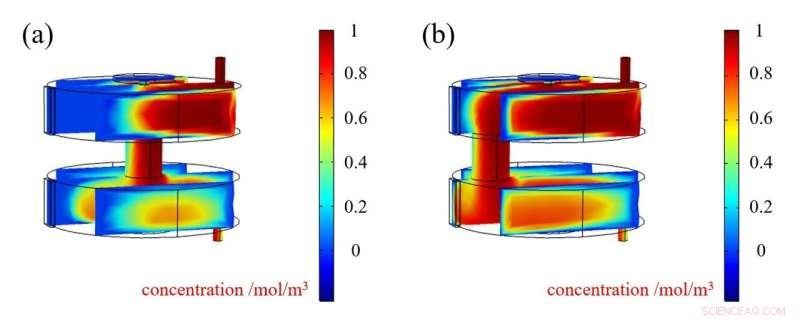
Simulation of the replacement rate of the measured gas; (a). the position of the connecting tube was not optimized; (b). the position of the connecting tube was optimized. Credit: Li Zhengang
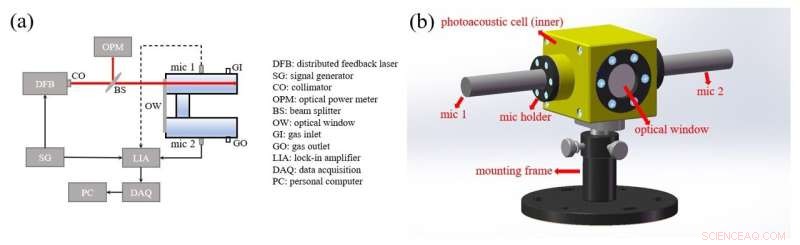
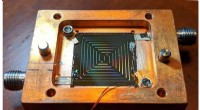
(a). Schematic diagram of the photoacoustic detection setup; (b). mechanical structure diagram of the photoacoustic cell. Credit: Li Zhengang
As for the coherent noise photoacoustic cell wall produced when absorbing light energy, they used wavelength modulation and second harmonic technology to suppress it.
The differential properties of the photoacoustic cell also helped to suppress the incoherent noise. The photoacoustic cell was also simulated and optimized in detail, which further improved the replacement speed of the measured gas while achieving superior performances.
The researchers tested it later in the methane gas detection experiment, and the photoacoustic cell showed good linearity and sensitivity.
When the excitation light source was a low-power (6 mW) near-infrared (1,653 nm) distributed feedback laser, the minimum detection limit of 177 ppb was achieved within one second detection time, and the corresponding normalized noise equivalent absorption coefficient was 4.1×10⁻¹⁰ cm–1WHZ–1/2. This was much more accurate than normalized noise equivalent absorption coefficients reported previously, which were about 10-8 to 10-10 order. + Explore further