* Gravity: The primary reason for their roundness is gravity. Gravity pulls everything towards the center of a mass. For large celestial bodies, the force of gravity is so strong that it pulls everything towards the center equally in all directions. This force works like a giant, invisible hand that smoothes out any bumps or irregularities.
* Not Perfectly Round: Planets, moons, and stars are not perfectly round. They tend to be slightly flattened at the poles and bulging at the equator due to the centrifugal force created by their rotation.
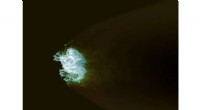
* Size Matters: The more massive an object is, the more its gravity will dominate and pull it into a more spherical shape. For example, asteroids and comets are much smaller and therefore not as round.
Here's an analogy: Imagine dropping a ball of playdough. It will flatten out and become round because gravity pulls it equally from all sides. Large celestial bodies work similarly, but on a much grander scale.
So, while they appear round to us, they are more accurately described as "oblate spheroids" which is a slightly flattened sphere.