There's a race happening in our solar system, but it has nothing to do with gravitational mechanics or velocity. Astronomers who study the gas giant planets of Saturn and Jupiter are in a close competition to see who can discover more moons. At this point, ringed Saturn is in the lead — but exactly how many moons does Saturn have? And how does that compare to massive Jupiter's count?
Currently, Saturn has 53 confirmed moons — this is the same number of confirmed moons as Jupiter. But Saturn is currently winning the gas giant moon race thanks to the 29 provisional moons that astronomers have discovered over the past few decades. (Jupiter has 26 provisional moons, currently.) A provisional moon is one that astronomers have discovered but is still awaiting additional observations to be confirmed.
Including provisional moons, Saturn has 82 total possible moons, while Jupiter has 79. Gas giants like these planets are so large and have such strong gravitational fields, they're able to attract far more satellites than a planet, like say, Earth, with its one moon. And these numbers of moons will likely change in the future as astronomers continue observing Saturn and Jupiter and the many bodies that orbit them both. Jupiter may even overtake Saturn at some point in the future.
While Jupiter is known for its four large Galilean moons (so named because they were observed by Galileo with his 17th century telescope), Saturn has two moons that have drawn astronomers' attention: Enceladus and Titan.
Both Enceladus and Titan are ocean moons, meaning they have subsurface oceans of liquid water. Titan even has surface lakes, though these are composed of methane and ethane. Enceladus is an icy moon known for spraying huge plumes of water up through its atmosphere into space; during the Cassini mission, astronomers were able to sample these geysers and that's how they discovered the ocean underneath its icy crust.
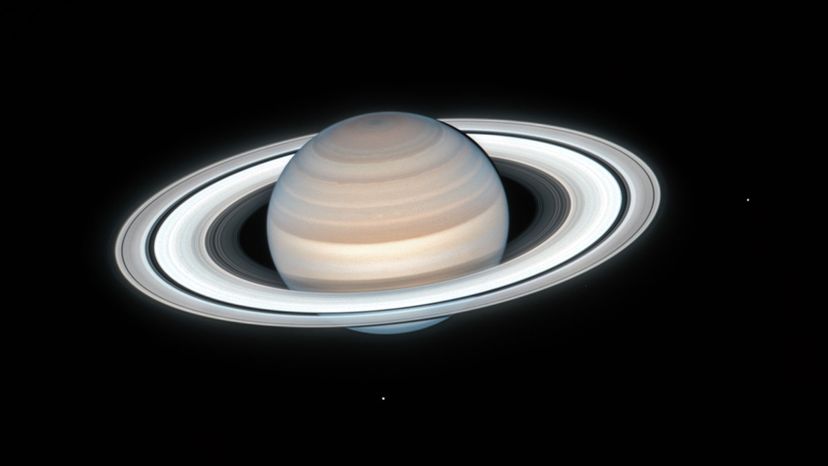
Saturn is most well-known for its big, beautiful rings, which are made of ice and rock. Some of these rocks and ice chunks are so large that they help shape the rings; NASA classifies these as "moonlets." Some of the first moonlets discovered were as big as a football field and cause gravitational changes in the rings — that's how astronomers discovered them. Some moonlets were caused by collisions in Saturn's rings, such as a larger moon breaking up at some point in Saturn's past.
Now That's InterestingSaturn's moons have many names, from cultures around the world. Some include Aegir (Norse), Bebhionn (Irish), Calypso (Greek), Ijiraq (Inuit) and Erriapus (Celtic). Saturn's provisional moons don't typically have a name until they are confirmed; instead their names will comprise a string of letters and numbers that denote its discovery year and other details for astronomers.