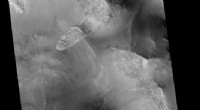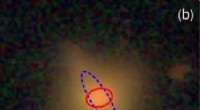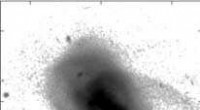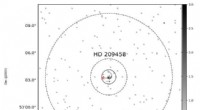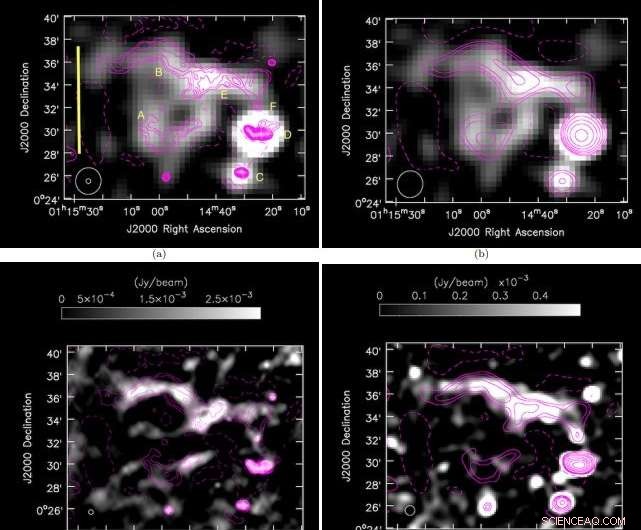
GMRT images of Abell 168. Credit: Dwarakanath et al., 2018.
Indian astronomers have detected two radio relics in the nearby merging galaxy cluster known as Abell 168. The discovery, which could improve our understanding of merging processes in galaxy clusters, was detailed March 16 in a paper published on the arXiv pre-print repository.
Radio relics are diffuse, elongated radio sources of synchrotron origin. They occur in the form of spectacular single or double symmetric arcs at the peripheries of galaxy clusters. Astronomers are especially interested in searching for such sources in merging galaxy clusters as the number of radio relics associated with merger shocks is still small.
Abell 168 is a nearby low-mass merging galaxy cluster at a redshift of 0.045 with a mass of about 152 trillion solar masses. First observations of radio emission associated with this cluster date back to 2011. Now, a team of researchers led by K. S. Dwarakanath of the Raman Research Institute in Bangalore, India, reports the finding of two radio relics in the Abell 168 galaxy cluster. The discovery was made using the Giant Metrewave Radio Telescope (GMRT) and the Karl G. Jansky Very Large Array (VLA).
"We report the discovery of twin radio relics in the outskirts of the low-mass merging galaxy cluster Abell 168 (redshift=0.045)," the researchers wrote in the paper.
GMRT and VLA observations revealed that one of the relics is elongated, thin and located toward the northern periphery of Abell 168 at a distance of about 3 million light-years from the cluster center. This relic has a linear extent of approximately 2.6 million light-years and a projected width of about 260,000 light-years.
The second newly found radio relic is ring-shaped and has a size of around 700,000 light-years. This radio source is located near the inner edge of the elongated relic, some two million light-years from the center of Abell 168. Moreover, the researchers found that the ring-shaped relic (source A) has a steeper spectral index of about -1.74 in the frequency range between 100 and 600 MHz and appears to be connected to the elongated relic (source B). They assume that the ring-shaped relic is old plasma revived due to adiabatic compression by the outgoing shock that produced the elongated relic.
"The orientation of source B, the projected distance between sources A and B, and the radiative lifetime of source A are consistent with such a scenario," the paper reads.
In concluding remarks, the authors noted that their study, besides identifying two new radio relics in Abell 168, provides an important information about the galaxy cluster itself. They emphasized that the discovery makes Abell 168 the lowest mass system so far known to have radio relics of merger shock origin.
© 2018 Phys.org