1. A Colorful and Chaotic Sky:
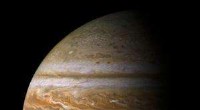
* Bands and Zones: Jupiter's atmosphere is divided into colorful bands and zones, created by different wind patterns and cloud formations. You'd see swirling bands of red, brown, yellow, and white, stretching across the vast sky.
* The Great Red Spot: This massive storm, larger than Earth, has raged for centuries. It would appear as a reddish oval, constantly churning and evolving.
* Lightning and Auroras: Jupiter experiences powerful lightning storms and spectacular auroras, much like Earth's Northern Lights. These would be incredible sights to witness.
2. A Constant Sense of Motion:
* High-speed Winds: Jupiter's atmosphere is incredibly dynamic. Winds can reach speeds of over 400 miles per hour, creating a constant sense of movement and turbulence.
* Storms and Turbulence: You'd see massive storms forming and dissipating, along with turbulent swirling clouds in a chaotic dance.
3. Extreme Pressure and Temperature:
* Crushing Pressure: As you descend deeper into Jupiter's atmosphere, the pressure increases dramatically. You'd be crushed by the weight of the atmosphere.
* Freezing Cold: The upper atmosphere of Jupiter is incredibly cold, reaching temperatures of -234 degrees Fahrenheit (-145 degrees Celsius).
4. No Solid Ground:
* Endless Gas: You would never reach a solid surface on Jupiter. It's a gas giant, so you'd be floating in a sea of gas, constantly moving and being tossed about by the winds.
5. A Glimmer of Distant Moons:
* Jupiter's Moons: Jupiter has dozens of moons, some of which would be visible in the sky. You might see the four largest moons, Io, Europa, Ganymede, and Callisto, as bright points of light in the distance.
Important Note: It's impossible for humans to survive on Jupiter. The conditions are far too extreme. However, we can explore it with spacecraft like the Juno mission, which has sent back amazing images and data about this giant planet.