The Pre-Supernova Star
* Massive Stars: Supernovas occur in massive stars, those at least 8 times the mass of our Sun.
* Nuclear Fusion: These stars spend their lives fusing lighter elements (like hydrogen and helium) into heavier ones (like carbon, oxygen, silicon, and iron) in their cores. This fusion releases immense energy, creating outward pressure that balances gravity.
* Iron Core: Eventually, the core reaches a point where it's mostly iron. Iron is the most stable element, and fusing it doesn't release enough energy to counteract gravity.
The Collapse
* Gravity Wins: Without the outward pressure from fusion, gravity takes over. The core collapses incredibly fast, shrinking from a size larger than Earth to the size of a small city in mere seconds.
* Neutron Degeneracy: As the core compresses, protons and electrons are forced together to form neutrons. This process creates intense pressure known as neutron degeneracy.
* Bounce and Shockwave: The core, now a dense ball of neutrons, suddenly stops collapsing. This abrupt halt creates a shockwave that races outward through the star.
The Explosion
* Supernova Blast: The shockwave tears through the star, blasting its outer layers into space at incredibly high speeds. This is the spectacular supernova explosion we observe.
* Elements Heavier Than Iron: The intense heat and pressure during the explosion forge elements heavier than iron, such as gold, platinum, and uranium. These are then scattered throughout the universe.
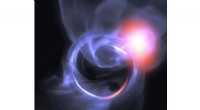
* Remnant: Depending on the star's mass, the supernova leaves behind either a dense neutron star (a spinning, incredibly dense object) or a black hole (a region of spacetime where gravity is so strong that nothing, not even light, can escape).
In Summary:
A supernova collapse is a rapid, violent event driven by the relentless force of gravity. The collapse triggers a catastrophic explosion that creates new elements and leaves behind a dense, collapsed remnant. It's a beautiful and awe-inspiring spectacle that plays a vital role in the universe's evolution, distributing elements and shaping galaxies.