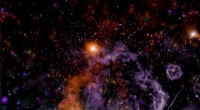
How a star's mass changes during its life:
* Nuclear Fusion: During its lifetime, a star fuses lighter elements (like hydrogen) into heavier elements (like helium, carbon, oxygen, etc.). This process releases enormous amounts of energy and is responsible for the star's light and heat. However, the fusion process also results in a tiny loss of mass, which is converted into energy according to Einstein's famous equation E=mc².
* Stellar Winds: Stars constantly lose some of their mass through stellar winds, which are streams of charged particles (mainly protons and electrons) blown off the star's surface. This loss is especially significant in the later stages of a star's life.
How a star's mass changes during death:
* Supernova: For massive stars, death comes in the form of a supernova explosion. During this cataclysmic event, a significant portion of the star's mass is ejected into space, forming nebulae and potentially contributing to the formation of new stars. However, a portion of the star's core collapses into a dense neutron star or even a black hole.
* White Dwarf: Less massive stars end their lives as white dwarfs. While these stars are extremely dense, they contain a significant portion of the original star's mass.
* Planetary Nebula: As a red giant star sheds its outer layers, it forms a beautiful planetary nebula. These nebulae consist of the star's expelled material, which is largely hydrogen and helium.
In Summary:
While a star does lose some mass through fusion and stellar winds during its life, the most dramatic mass loss occurs during its death. The amount of mass lost depends on the star's initial mass and how it dies. However, the core remnants of the star (neutron star, black hole, or white dwarf) retain a significant portion of the star's original mass.