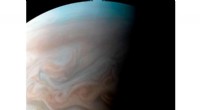
1. A Giant Vortex: The Great Red Spot is essentially a massive, rotating storm, similar to hurricanes on Earth, but much larger and more enduring. It's a high-pressure system where winds circulate counterclockwise.
2. Formation Theories:
* Atmospheric Instability: One theory suggests the Great Red Spot formed due to atmospheric instability in Jupiter's upper atmosphere. This instability could have created a large-scale vortex that eventually grew into the massive storm we see today.
* Merging Storms: Another theory posits that the Great Red Spot formed from the merger of several smaller storms. As these storms collided, they combined their energy and momentum, creating a single, powerful vortex.
3. Long-Lasting Due to Jupiter's Rotation:
* Jupiter's rapid rotation plays a crucial role in the Great Red Spot's longevity. The planet rotates once every 10 hours, creating strong jet streams that help maintain the storm's structure.
* The lack of any solid surface for the storm to interact with also allows it to persist for such a long time.
4. Ongoing Research:
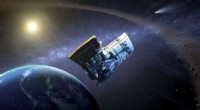
* The exact processes that led to the formation of the Great Red Spot are still under investigation. Scientists use spacecraft like Juno to observe the storm's structure, composition, and dynamics, hoping to understand its origins better.
5. Unique Characteristics:
* The Great Red Spot's color is thought to be caused by trace amounts of phosphorus and sulfur compounds in the storm's clouds. These compounds are raised to higher altitudes by the storm's strong winds, where they are exposed to sunlight and become colored.
In Conclusion: While the exact formation process of the Great Red Spot is still being investigated, it's likely a combination of atmospheric instability, merging storms, and Jupiter's unique characteristics that contributed to its creation and long-lasting existence. Its study provides invaluable insight into the dynamics of giant planets and their atmospheres.