1. Energy Output:
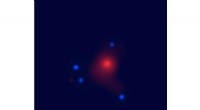
* Quasars: Are incredibly luminous, emitting the energy of billions of stars. They are powered by supermassive black holes at the centers of galaxies, accreting matter and releasing tremendous amounts of energy.
* Stars: Are much fainter and their energy output is determined by nuclear fusion in their cores.
2. Size:
* Quasars: Are not physical objects like stars but are the incredibly bright cores of distant galaxies. The supermassive black hole at the center is comparatively small, but the accretion disk and surrounding gas are very large, encompassing a significant portion of the host galaxy's core.
* Stars: Are individual, self-luminous spheres of plasma held together by gravity.
3. Distance:
* Quasars: Are extremely distant objects, typically billions of light-years away.
* Stars: The vast majority of stars we see are within our own Milky Way galaxy, relatively close by compared to quasars.
4. Spectrum:
* Quasars: Have unique spectra with strong emission lines that indicate the presence of hot, ionized gas. These lines are often redshifted due to the expansion of the universe.
* Stars: Have spectra that show absorption lines, indicating the presence of elements in their atmospheres.
5. Variability:
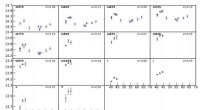
* Quasars: Can be highly variable in brightness over short time scales, indicating changes in the accretion rate of matter onto the central black hole.
* Stars: While some stars are variable, their variations are typically much slower and less dramatic than those seen in quasars.
In essence:
* Quasars are powered by supermassive black holes and are incredibly luminous, distant, and variable.
* Stars are self-luminous spheres of plasma powered by nuclear fusion, much smaller and closer to us than quasars.
While both quasars and stars emit light, their energy sources, sizes, and characteristics are fundamentally different.