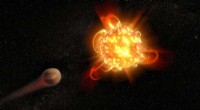
In the core of a star, hydrogen atoms are stripped of their electrons, leaving behind only the atomic nuclei, known as protons. Under the extreme conditions of high pressure and temperature, these protons have enough kinetic energy to overcome the repulsive electromagnetic force between them and fuse together.
When two protons fuse, they form a deuterium nucleus, which quickly captures another proton to form a helium-3 nucleus. The fusion of helium-3 nuclei produces helium-4, releasing a significant amount of energy in the form of gamma rays. This energy release contributes to the star's outward pressure, counteracting the gravitational force that pulls the star's matter inward.
As long as there is sufficient hydrogen fuel in the core, the star continues to fuse protons into helium through a series of nuclear reactions. This process sustains the star's internal energy production and maintains its equilibrium against gravitational collapse. The rate of fusion depends on the star's mass, composition, and evolutionary stage. More massive stars have higher core temperatures and pressures, allowing for more rapid fusion rates.
The onset of nuclear fusion marks the beginning of a star's life on the main sequence phase of its evolution. During this stage, the star's energy production is relatively stable, and it shines steadily with a characteristic color and brightness that depend on its surface temperature. Ultimately, the star's fusion processes evolve as it consumes its hydrogen fuel, leading to various stages of stellar evolution, including the red giant phase, where the star fuses heavier elements in its core, and eventually to the ultimate fate of the star, such as becoming a white dwarf, neutron star, or black hole.