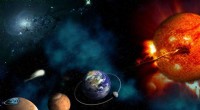
After the Big Bang, the universe rapidly expanded and cooled, allowing subatomic particles to form. Over time, these subatomic particles combined and formed atoms, molecules, and eventually stars, galaxies, and the vast cosmic structure we observe today.
The timeline of the universe's development can be summarized as follows:
Planck epoch: This was the first and smallest unit of time after the Big Bang. During this period, which lasted from the moment of the Big Bang up to 10^-43 seconds, the universe was extremely hot and dense, and the laws of physics as we know them today did not apply.
Grand Unification epoch: This epoch followed the Planck epoch and lasted for about 10^-36 to 10^-32 seconds. During this stage, the universe's temperature began to cool, allowing for the formation of subatomic particles like quarks and gluons.
Electroweak epoch: The next phase, lasting from 10^-32 to 10^-10 seconds, was marked by the unification of the electromagnetic and weak forces. This led to the separation of quarks into protons and neutrons and the formation of electrons, positrons, neutrinos, and antineutrinos.
Inflationary epoch: This period of rapid expansion lasted from about 10^-35 seconds to 10^-32 seconds. During this stage, the universe expanded at an exponential rate, stretching the universe to its current size and setting the stage for the formation of galaxies and cosmic structures.
Cooling and matter formation: As the universe continued to expand and cool, protons and neutrons combined to form atomic nuclei. The first atoms, consisting of hydrogen, helium, and some lithium, were created. These atoms formed the primordial gas that eventually collapsed under gravity to form stars and galaxies.
Cosmic structure formation: Over billions of years, gravitational interactions caused the primordial gas clouds to condense and fragment, forming stars and galaxies. The cosmic structures that we observe today, including stars, galaxies, galaxy clusters, and superclusters, evolved through gravitational interactions and mergers of these early structures.
It is worth noting that our understanding of the universe's early stages and the timeline of its evolution comes from scientific theories and models. While these models have been extensively tested and refined based on observations and theoretical calculations, there are still aspects of the universe's origin and evolution that remain subjects of ongoing scientific research and exploration.