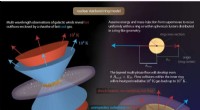
1. Complementary Information: Different wavelengths provide complementary information about an object. For example, visible light observations reveal the object's shape, color, and surface features, while infrared observations can detect heat signatures and hidden structures. X-ray and gamma-ray observations can reveal high-energy processes like black holes and supernovae. Combining data from multiple wavelengths provides a more complete picture of the celestial object.
2. Unveiling Hidden Phenomena: Some celestial objects or phenomena may only be visible in specific wavelength ranges. For instance, interstellar gas clouds are best observed in the infrared, while radio telescopes detect emissions from regions with strong magnetic fields. By observing in different wavelengths, astronomers can uncover hidden processes and structures that would otherwise remain undetected.
3. Understanding Physical Processes: Multi-wavelength observations allow scientists to study physical processes occurring within and around celestial objects. For example, comparing optical observations of a star with X-ray or ultraviolet observations can reveal information about its temperature, stellar winds, and the presence of an accretion disk. Similarly, radio observations can provide insights into the dynamics of galaxies and star formation regions.
4. Probing Different Layers: Celestial objects often have complex structures with different layers or components. By observing in multiple wavelengths, astronomers can probe these layers and study the variations in temperature, density, ionization state, and chemical composition. This helps unravel the object's internal structure and evolutionary history.
5. Comparative Studies: Multi-wavelength observations enable comparative studies of different objects, such as stars of different types, galaxies in various stages of evolution, or active galactic nuclei. By comparing observations across multiple wavelengths, astronomers can identify patterns, similarities, and differences, leading to a deeper understanding of the diversity and properties of celestial objects.
6. Searching for Exoplanets: In the search for exoplanets, multi-wavelength observations play a crucial role. Transits of planets in front of their host stars can be detected in the optical or infrared, while radial velocity measurements, which reveal the slight wobbles induced by orbiting planets, are made using spectroscopic techniques. Combining these observations helps confirm the presence and characteristics of exoplanets.
7. Time-Dependent Phenomena: Some celestial phenomena, such as variable stars, pulsars, or supernovae, exhibit changes over time. By observing these objects in multiple wavelengths, astronomers can track their evolution and study the underlying processes responsible for their variability.
In summary, observing a celestial object in multiple parts of the electromagnetic spectrum allows astronomers to obtain a more comprehensive understanding of its nature and behavior. By combining information from different wavelengths, scientists can uncover hidden phenomena, probe various layers, study physical processes, conduct comparative studies, search for exoplanets, and track time-dependent changes. Multi-wavelength observations are essential for advancing our knowledge of the universe and unlocking the secrets of celestial objects.