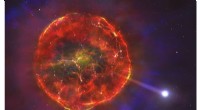
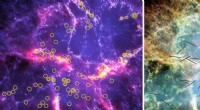
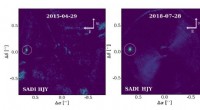
2. Supernovae: Supernovae are the result of the explosive deaths of massive stars. During a supernova, a tremendous amount of energy is released, producing a brief but incredibly bright flash of light. The light curves of supernovae can vary depending on the type of supernova, but they typically reach their peak luminosity within a few days to weeks.
3. Gamma-ray bursts (GRBs): GRBs are extremely energetic explosions that release an immense amount of gamma rays, the highest energy form of electromagnetic radiation. They are believed to be associated with the collapse of massive stars or the mergers of neutron stars and black holes. GRBs are short-lived, lasting only a few milliseconds to a few minutes, but their peak luminosities can be enormous.
4. Blazars: Blazars are a type of active galactic nuclei (AGN) that have jets of particles ejected from their central black holes aligned directly towards Earth. As these jets are highly relativistic, they produce a powerful beaming effect, making blazars appear extremely luminous when observed from our line of sight.
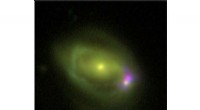
5. Tidal disruption events (TDEs): TDEs occur when a star passes too close to a supermassive black hole and is torn apart by the immense tidal forces. The resulting accretion process can generate a tremendous amount of luminosity, particularly in the ultraviolet and X-ray bands.
6. Active Galactic Nuclei (AGN): AGN are the bright, central regions of galaxies that are powered by the accretion of matter onto a supermassive black hole. They can emit significant amounts of light across a wide range of wavelengths, including visible light, infrared, and X-rays.
These are some of the most intense sources of light in the universe, emitting vast amounts of energy and illuminating the cosmos with their brilliant radiance.