1. Definition: A stellar nebula is a large-scale cloud of gas and dust found in interstellar space. It constitutes the raw material from which stars form through gravitational collapse.
2. Stages of Stellar Evolution: Stellar nebulae are associated with the early stages of star formation. They represent a dense region of the galaxy where star formation is actively taking place.
3. Size: Stellar nebulae can be vast in size, spanning hundreds to thousands of light-years across.
4. Structure and Appearance: Stellar nebulae often have intricate structures, such as pillars, filaments, and globules. They emit light due to the presence of hot, young stars embedded within them.
5. Regions of Star Birth: Stellar nebulae serve as birthplaces for new stars. The gravitational pull within the nebula causes the gas and dust to clump together, forming dense cores that eventually ignite nuclear fusion and become stars.
6. Example: The Orion Nebula is a well-known stellar nebula, famous for its distinctive shape and the presence of numerous star-forming regions.
Planetary Nebula:
1. Definition: A planetary nebula is a shell of expanding ionized gas that is expelled by certain types of stars (red giants) during the late stages of their evolution.
2. Stages of Stellar Evolution: Planetary nebulae are associated with the final stages of a star's life, particularly for stars with low to intermediate masses (usually between 0.8 and 8 solar masses).
3. Size: Planetary nebulae are relatively smaller than stellar nebulae, typically spanning a few light-years in diameter.
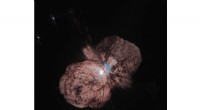
4. Structure and Appearance: Planetary nebulae often have intricate and beautiful shapes, such as rings, shells, or spirals. They emit colorful light resulting from the high-energy radiation emitted by the central star.
5. Remnants of Red Giant Phase: Planetary nebulae arise when the outer layers of a red giant star are expelled due to intense stellar winds and radiation pressure. The cast-off material forms the visible nebula.
6. Fate of the Central Star: After shedding its outer layers, the core of the star remains, becoming a hot white dwarf. As the nebula disperses over time, the white dwarf cools down.
7. Example: The Ring Nebula (M57) is a famous planetary nebula, showcasing a ring-like structure and intricate patterns.
To summarize, the main difference between a stellar nebula and a planetary nebula lies in the stage of stellar evolution they are associated with. Stellar nebulae represent regions of star birth, while planetary nebulae are the result of the final stages of evolution for certain stars. Their sizes, structures, and origins differ accordingly.