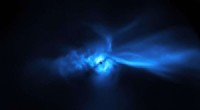
1. Stars: The central region of the Milky Way is home to a massive concentration of stars, including old and young populations, which emit both visible light and other types of radiation. The high density of stars in this region gives rise to a bright and luminous appearance.
2. Stellar Clusters: Within the central region, there are numerous star clusters, such as the Arches Cluster and the Quintuplet Cluster, which contain thousands of young, hot, and massive stars. These star clusters emit intense ultraviolet (UV) radiation and contribute significantly to the overall luminosity of the galactic center.
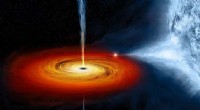
3. Supermassive Black Hole (Sagittarius A*): At the very center of the Milky Way lies a supermassive black hole called Sagittarius A* (Sgr A*). While black holes themselves do not emit light directly, the gravitational forces they exert on the surrounding matter create several luminous phenomena. Accretion disks and jets of high-energy particles near the black hole generate strong emissions in the infrared, X-ray, and radio wavelengths.
4. Gas and Dust: The galactic center also contains large amounts of gas and dust, which play a crucial role in the overall light output. Hot, ionized gas, known as HII regions, emits light due to the intense radiation from nearby stars and the black hole. Additionally, dust particles scatter and reflect starlight, contributing to the diffuse glow of the galactic center.
5. Synchrotron Radiation: High-energy electrons in the central region of the Milky Way move in the strong magnetic fields and spiral around the field lines. This motion gives rise to synchrotron radiation, which is emitted as a continuous spectrum from radio waves to X-rays.
It's important to note that the different light sources in the middle Milky Way galaxy emit over a broad range of wavelengths, making it a rich target for observations across the entire electromagnetic spectrum.