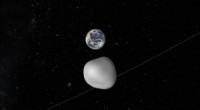
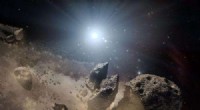
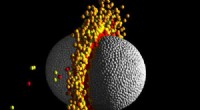
The most commonly accepted theory of moon's formation is the giant impact hypothesis. This theory suggests that the moon was formed when a Mars-sized body called Theia collided with Earth about 4.5 billion years ago. The collision is thought to have ejected a large amount of debris into orbit around Earth, which eventually coalesced to form the moon.
Key Points
- The giant impact hypothesis explains why most of the moon is made of the same type of rock that is found in Earth's mantle, rather than the crust
- This theory also helps to explain why the moon has a relatively small iron core, and why its orbit is tilted relative to Earth's equator
- The giant impact hypothesis is supported by a number of lines of evidence, including computer simulations of the collision, and the presence of lunar samples containing impact-generated materials.