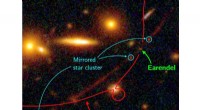
1. Gravitational Lensing: The immense gravitational field of massive objects, such as stars and planets, can cause the path of photons to bend. This phenomenon, known as gravitational lensing, acts like a lens that warps the light's trajectory. As photons from the sun pass near celestial objects, their path may be altered due to gravitational lensing.
2. Scattering by Particles: In the vast expanse of space, there are numerous particles, including dust, interstellar gas, and plasma. These particles can interact with photons through scattering. When photons collide with particles, their direction can be changed, causing them to deviate from their original trajectory.
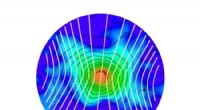
3. Interaction with Magnetic Fields: Magnetic fields are present throughout space, generated by various astronomical phenomena. As photons travel through regions with magnetic fields, they can experience forces that influence their path. The interaction between photons and magnetic fields can lead to changes in the direction and polarization of the light.
4. Solar Wind: The sun emits a stream of charged particles known as the solar wind. These particles travel through space and can interact with photons. The interaction with the solar wind can cause the deflection or absorption of photons, affecting their path towards the Earth.
5. Cosmic Events: In rare circumstances, catastrophic cosmic events like supernovae or collisions between celestial objects can produce shockwaves and disturbances in the fabric of space-time. These events have the potential to disrupt the path of photons, causing them to deviate from their expected straight-line trajectory.
While the overall path of sunlight remains relatively direct, these factors can induce slight deviations and alterations in the photon's journey from the sun to the Earth. These influences highlight the complexities of the cosmos and the intricate nature of light's propagation through the vastness of space.