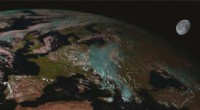
Gravitational Forces: The Sun, Moon, and Earth interact through gravitational forces. The Sun's gravity keeps the planets, including Earth, in orbit around it. The Moon's gravity influences Earth's tides and contributes to the stabilization of Earth's rotational axis.
Tidal Effects: The Moon's gravity primarily causes ocean tides on Earth. As the Moon orbits Earth, its gravitational pull creates bulges in the ocean, resulting in high and low tides. The Sun also contributes to tidal forces, but its effect is less significant compared to the Moon's.
Eclipses: The alignment of the Sun, Moon, and Earth leads to various eclipse phenomena. A solar eclipse occurs when the Moon passes between the Sun and Earth, blocking the Sun's light from reaching certain regions on Earth. A lunar eclipse occurs when Earth's shadow falls on the Moon, making it appear dark or reddish.
Illumination and Seasons: The Sun is the primary source of light and heat for the Earth-Moon system. The Earth's rotation and revolution around the Sun, combined with the Moon's orbit around Earth, result in the changing seasons and day-night cycles on Earth.
Lunar Phases: The Moon's appearance changes as it orbits Earth. As the positions of the Sun, Earth, and Moon change, different portions of the Moon are illuminated by sunlight. This leads to the various lunar phases, such as the new moon, full moon, and crescent moon.
Understanding the relationships between the Sun, Moon, and Earth is essential in studying celestial mechanics, astronomy, and the dynamics of our solar system. These relationships have fascinated scientists, astronomers, and observers throughout history and continue to shape our understanding of the universe.