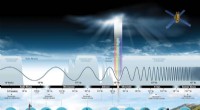
Here's how the temperature change occurs in the stratosphere with increasing altitude:
1. Ozone Absorption: Ozone (O3) molecules in the stratosphere absorb high-energy UV radiation from the sun. This absorption process converts UV energy into heat, leading to an increase in temperature.
2. Solar Heating: As the ozone layer absorbs more UV radiation with increasing altitude, more heat is generated, resulting in a gradual rise in temperature. This heating effect is most prominent in the lower and middle stratosphere.
3. Radiation Balance: In the stratosphere, the radiative heating from ozone absorption balances the radiative cooling due to the emission of infrared (IR) radiation by CO2 and other greenhouse gases. This balance maintains a relatively stable temperature profile.
4. Temperature Inversion: The temperature increase with altitude in the stratosphere creates a temperature inversion compared to the troposphere. While the troposphere experiences a temperature decrease with altitude, the stratosphere shows an opposite trend.
5. Stratospheric Layers: The stratosphere can be further divided into layers based on temperature characteristics. The lower stratosphere (up to about 25 km) exhibits a gradual temperature increase, while the upper stratosphere (above 25 km) shows a more stable or slightly decreasing temperature trend.
It's important to note that the temperature variation in the stratosphere can be influenced by various factors, including latitude, season, and solar activity. However, the overall temperature profile in the stratosphere is characterized by an increase in temperature with altitude due to ozone absorption and solar heating.