Two exoplanets, HD 41248 b and c, orbit a young G-type (Sun-like) star located approximately 177 light-years (1,665 trillion km) away in the constellation of Auriga.
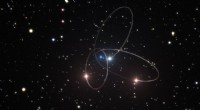
"The eccentricity value gives information about how elliptical an orbit is. If the value is zero, we deal with a perfect circle; but an orbit is called highly eccentric if its value reaches above ~0.9. In this sense, both discovered Jupiter-like planets have very pronounced elliptical orbits around their host star,'' says Dr Man Ho Chan from CfA/Harvard & Smithsonian. “Such extreme eccentricity, in addition to other intriguing features of HD 41248 b and c, provide an exciting opportunity to better understand various properties of Jupiter-like planets that formed or migrated very close to their central stars during the early formation of planetary systems.“
One explanation to such pronounced and aligned ellipticities could be a Kozai migration in a stellar binary system with an additional eccentric orbit, Dr Ji Wang from CfA continues,'' which could imply an ongoing dynamical interaction within the surrounding environment of these two exoplanets.''
For more information click here: https://www.space.com/mystery-solved-how-exoplanets-eccentric-orbits-formed