1. Monitor Accretion Disks:
Black holes are often surrounded by accretion disks, rings of gas and matter that swirl around them. In the case of ultra-fast-spinning black holes, the accretion disks are expected to exhibit certain characteristics.
- Disk's Thickness: Rapid rotation causes the accretion disk to become geometrically thin. This thinness is a telltale sign of a high spin rate.
- Disk's Inner Radius: The inner edge of the accretion disk, known as the innermost stable circular orbit (ISCO), is smaller for faster-spinning black holes. Observations that reveal a small ISCO can indicate a high spin rate.
2. Inspect X-ray Emission:
X-rays are emitted from the hot gas within the accretion disk. The properties of X-ray emission can provide clues about the black hole's spin:
- Spectral Analysis: Spectral analysis of the X-ray emission can reveal specific features, such as the "relativistic reflection spectrum," which is associated with rapidly spinning black holes.
- Light Curves: Monitoring X-ray light curves, or variations in X-ray brightness, can help identify dips or modulations caused by the strong gravity and rapid rotation of the black hole.
3. Observe Relativistic Jets:
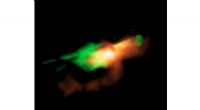
Ultra-fast-spinning black holes often launch powerful jets of matter and energy along their rotation axes. These jets are called relativistic jets because they move close to the speed of light. Detecting and studying these jets can indicate a high spin rate.
4. Use Gravitational Wave Signals:
Gravitational wave astronomy provides another means of identifying fast-spinning black holes. The signals detected by gravitational wave detectors like LIGO can carry information about the spin of the merging black holes.
- Waveform Analysis: Analyzing the gravitational wave signals can reveal features that indicate high spins, such as precession and higher-order harmonics.
5. Study Disk-Jet Connection:
The connection between the accretion disk and relativistic jets is believed to be governed by the black hole's spin. By studying the properties and dynamics of this disk-jet connection, astronomers can infer the spin rate.
6. Multi-Wavelength Observations:
Combining observations across different wavelengths, including radio, optical, infrared, and X-ray, can provide a more comprehensive view of the black hole's surroundings and help determine its spin rate.
7. Advanced Computational Models:
Theoretical models and numerical simulations of black hole accretion disks and relativistic jets can help interpret observations and provide insights into the spin rate.
By employing these techniques, astronomers can delve into the mysteries of the universe's fastest-spinning black holes, gaining a deeper understanding of these enigmatic cosmic objects and their role in shaping the universe.