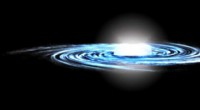
The picture shows a doughnut-shaped ring of matter about 13,000 times larger than our solar system's Kuiper Belt, a cold region of icy bodies beyond Neptune. The new planet is located along one side of the doughnut's inner hole.
The planet is nestled within a dusty cocoon known as a protoplanetary disk, a swirling vortex of gas and dust from which planets are born. The disk spreads outward from the center, and the planet orbits a young, massive star, known as a protostar, at the heart of the structure.
The newly discovered planet is thought to be between 1 million and 10 million years old, making it an infant on the cosmic scale. Our own solar system is about 4.6 billion years old.
Observations of young stars surrounded by protoplanetary disks are helping astronomers better understand the early phases of planetary formation — a stage that until now has been shrouded in mystery. These new findings help us understand the processes by which rocky, terrestrial worlds like Earth and huge, gaseous worlds like Jupiter evolved from the same primordial stuff.
The planet orbits the star about 85 astronomical units away. An astronomical unit is the distance from Earth to the sun — about 93 million miles (150 million kilometers).
"We are seeing a planet in its most nascent stage of formation," said John Bally of the University of Colorado, Boulder, lead author of a paper on the discovery appearing in the Astrophysical Journal. "This is akin to observing a human fetus. We are witnessing events that only take place during a very short window in the life of a planetary system."
The Spitzer observations are consistent with models that predict the first stage in planet formation occurs when small grains of dust in a protoplanetary disk agglomerate to form larger pebble-sized objects, which then further collide to form ever-larger bodies called planetesimals and eventually full-fledged planets.
How exactly protoplanetary disks form planets remains uncertain. One theory is that as dust particles whirl around the protostar, they bump into each other and stick together. As these clumps grow larger, they are able to collect more material due to their powerful gravity, enabling them to sweep up even more debris from the surrounding disk as they rapidly grow.
Eventually, they accumulate enough mass to form protoplanets. Over time, these protoplanets collide with and gravitationally attract other protoplanets, forming the rocky cores of much larger planets. The protoplanets likely experience hit-and-run interactions that occasionally knock them off course, causing them to crash into other, larger bodies. These collisions cause protoplanets to either shatter or merge with the other objects. Over time, these large impacts will sculpt planets into spheres and give them their rocky surfaces.
A planet's density determines how many more collisions it will experience. As planets become denser, they are better at pulling objects in through gravitational attraction.
Spitzer's view of this nascent planetary system may provide critical insights into the nature of these collisions. The researchers believe the bright "arc of light" opposite the planet in the disk hints at a catastrophic impact involving two other protoplanets that likely took place a mere 100,000 years ago.
"By studying these early planet-building blocks and the process by which these clumps grow, we are better understanding the conditions that give rise to planetary formation," Bally said.