New simulations carried out by researchers from the Max Planck Institute for Astrophysics suggest that supermassive black holes (SMBH) at the centers of massive galaxies can quench star formation in their host galaxies by preventing cold, star-forming gas from accumulating in the central regions.
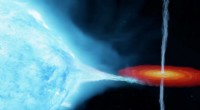
Massive galaxies in our Universe contain central supermassive black holes and these black holes are known to be the main drivers of Active Galactic Nuclei (AGN). An AGN is primarily a supermassive black hole that accretes matter from the surrounding medium, and expels part of the accreted material back into the interstellar medium in the form of highly energetic outflows.
The outflows from the AGN can heat the gas and thereby prevent the gas from cooling and condensing into stars. In massive galaxies, the accretion of gas onto the supermassive black hole occurs primarily through cold, molecular gas that flows inward along filaments or streams from large distances in the galaxy.
The hot AGN outflows can disrupt and destroy the incoming filaments, thereby choking off the fuel supply to the central black hole and causing a decrease in the star formation rate.
Although observations have shown that such central inflows of cold molecular gas exist, the impact of the central AGN outflows in shutting down these inflows has not been directly seen so far.
In this work, the researchers investigated the interplay between the inflows and outflows by performing high-resolution three-dimensional magneto-hydrodynamic simulations of a massive, rotating galaxy containing a central SMBH.
They found that the hot AGN outflows can indeed disrupt and destroy the incoming cold inflows. Furthermore, the simulations showed that the inflows can continue to penetrate deeply toward the black hole only through dense gas environments that shield the inflows from the destructive impact of the outflows.
The researchers conclude that in the presence of hot, central AGN outflows, cold gas inflows toward the central SMBH can be sustained only in the dense regions of the galaxy. Since most of the gas in massive galaxies resides in filamentary low-density regions outside of the dense circumnuclear regions, the inflow shutdown due to AGN outflows can significantly reduce the amount of gas available for star formation in these galaxies.