The first hot Jupiter was discovered in 1995, orbiting the star 51 Pegasi. Since then, over a hundred other hot Jupiters have been discovered. Most hot Jupiters are found orbiting stars of spectral types F, G, and K, which are hotter and more massive than the Sun.
Hot Jupiters are thought to form in the outer regions of their planetary systems and then migrate inwards towards their host stars. This migration is likely caused by interactions with the protoplanetary disc, the disc of gas and dust from which planets form. As a hot Jupiter migrates inwards, it loses angular momentum and its orbit becomes smaller and more eccentric.
The close proximity of hot Jupiters to their host stars can have a number of effects on their atmospheres and surfaces. The intense stellar radiation can cause the atmosphere of a hot Jupiter to be stripped away, leaving behind a rocky core. In some cases, the atmosphere may be heated to such high temperatures that it becomes ionized, creating a "hot Jupiter corona".
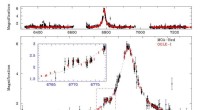
The strong gravitational forces exerted by hot Jupiters can also affect the rotation of their host stars. The gravitational pull of a hot Jupiter can cause the star to wobble or "wobble", which can be detected by precise measurements of the star's radial velocity. This method is commonly used to detect the presence of hot Jupiters orbiting stars.
Hot Jupiters are important objects of study for astronomers because they provide insights into the formation and evolution of planetary systems. They also offer a unique opportunity to study the extreme conditions that can exist on exoplanets.