1. Gravitational Interactions: As galaxies approach each other during a merger, their SMBHs start interacting gravitationally. The gravitational forces between the black holes cause them to move closer to each other over time.
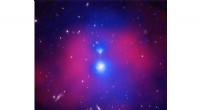
2. Formation of a Dual Active Galactic Nucleus (AGN): In the early stages of the merger, both SMBHs can be actively accreting matter and producing jets of high-energy particles and radiation. This phase is known as a dual active galactic nucleus (AGN) phase. The presence of two AGNs can have a significant impact on the surrounding gas and star formation within the merging galaxies.
3. Dynamical Friction: As the SMBHs continue to interact, dynamical friction plays a role in bringing them closer together. Dynamical friction occurs due to gravitational interactions between the SMBHs and the stars and gas in the merging galaxies. The stars and gas exert a drag force on the black holes, causing them to lose energy and spiral inward.
4. Formation of a Single SMBH: Eventually, the two SMBHs come very close to each other and form a single, more massive black hole. The process of merging involves the release of a tremendous amount of gravitational energy, which can produce gravitational waves and contribute to the overall energy output of the galaxy merger.
5. Recoil of the Merged SMBH: In some cases, the merging SMBHs can experience a recoil due to the conservation of momentum. This recoil can propel the merged black hole out of the center of the newly formed galaxy, leading to the formation of an off-center SMBH.
6. Coevolution with the Galaxy: The merged SMBH continues to interact with the surrounding gas and stars in the galaxy. The black hole can accrete matter and grow in mass, influencing the star formation and overall evolution of the host galaxy.
The study of SMBH interactions and mergers plays a crucial role in understanding the formation and growth of galaxies, as well as the evolution of the universe. It provides insights into the dynamics of galaxy mergers, the formation of massive black holes, and the interplay between black holes and their host galaxies.